
Here we examine what is driving interest rates higher, what this means for bonds, and the risks and opportunities for investors.

Bonds provide a fairly certain income stream and the potential to out-perform when equities decline.
Bond play a key role in our clients’ portfolios. They generate a fairly certain income stream and can provide a strong diversification benefit. In a typical downside ‘shock’ to economic growth, equities often fall, central banks cut rates, and this serves to increase bond prices as both short and longer-term interest rates fall. But it doesn’t always work like this. In a ‘shock’ that instead causes inflation to rise, such as we are seeing now with the war in Iran, interest rate expectations increase, causing bond prices to fall. We would normally also expect equities to fall when interest rates rise via an inflationary shock because of the likely negative impact on GDP growth and corporate earnings, and also because of the higher discount rate applied to those earnings. In the event, we have not seen this over 2026 because the very strong tailwind from corporate earnings has outweighed these impacts on equities.
They generate a fairly certain income stream and can provide a strong diversification benefit.
Bond prices are a function of short and longer-term interest rates depending on the term of the bond.
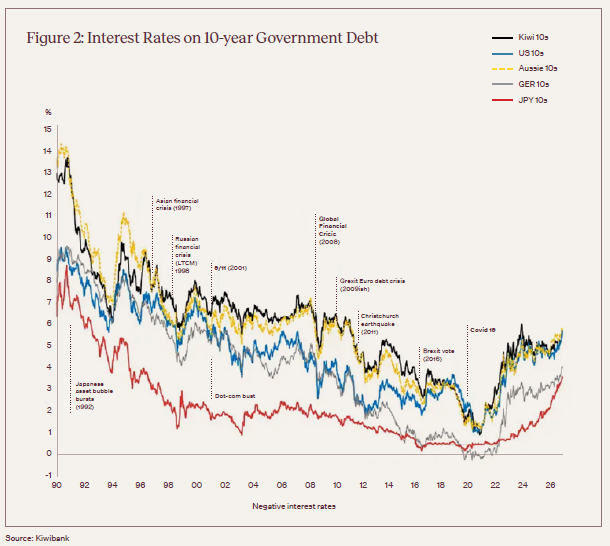
While a country’s short-term interest rate changes are mainly driven by its domestic monetary policy, longer-term interest rates are much more driven by its fiscal policy settings and related government debt trajectory. Over the past 3 months or so, markets have increasingly focused on this issue. Long-term (30-year) government bond yields reached multi-decade highs in August across several major markets (the US, Japan, the UK and Euro Area economies) and rates have remained elevated. Ten-year government bond yields, which are a much more important benchmark for bonds issuance and the cost of borrowing in global markets, also reached the highest levels seen in many years (see Figure 2 below). Importantly, these shifts occurred despite economic data being relatively soft, suggesting that the re-pricing has not been due to expectations for growth or for monetary policy over the new few years.
Markets are increasingly focusing on the long-term supply of bonds and the compensation (term premium) required by investors for holding them.
Central banks have been increasing short-term rates in response to inflation risks.
Short-term interest rates are projected to rise further given inflation rates remain above targets (with upside risk stemming from oil and gas prices), but yield curves, i.e. the path expected for future rates, imply rising rates well beyond the horizon of monetary policy leaning against current inflationary pressures. This is because markets are increasingly focusing on the long-term supply of bonds and the compensation (term premium) required by investors for holding them.
Long-term rates have also been rising because of fiscal risks and the supply versus demand balance for bonds.
Governments continue to run very large deficits, Japanese investors have begun to re-allocate from global to domestic bonds as their home yields have risen, and we now have major issuance of investment grade bonds by AI-related hyper-scalers competing for the same pool of capital. In response, the US Treasury increased buy-backs of long-term bonds, and also intervened in the USD-Yen currency market to arrest the yen’s decline, but these moves have been ineffective in reversing the trends. The key question is how much further could rates rise?
The key question is: how much further could rates rise?
Higher interest rates means higher borrowing costs for governments, corporates and households.
The consensus view amongst one group of experts - bond managers - is that the rate rises have already gone too far, and in response we have seen many fixed income managers increasing duration, i.e. the average term of the bonds held, in their funds. However, the implicit assumption here is that governments and corporate issuers continue to meet their obligations to bond holders, without a material increase in default risk. It also assumes that borrowers can continue to roll over their borrowing, and that there are no major failures in bond auctions or, more broadly, in the ‘plumbing’ of the financial system.
Governments will be forced to tighten fiscal policy if interest rates rise much further given debt levels are very high.
Our view is that ultimately if rates continue to rise it will force changes in fiscal policy, and that the wall of issuance by hyper-scalers may hasten this day. The hyper-scalers are large enough, profitable enough and apparently committed enough to the build-out of AI infrastructure that they are likely to continue to issue even if their cost of borrowing needs to rise materially to entice investors. That is, they are likely much less price sensitive than government issuers, and as such may set the marginal price (interest rate) at which bonds are bought by investors. In turn, this may mean that governments lose ‘affordable’ access to debt markets, and are forced into fiscal tightening to reduce both the term premium investors require from their bond issuances and the quantum of borrowing required.
The arithmetic for governments is clear and brutal in this regard. For any country with a net debt/GDP ratio of 100% or more (which currently includes the US, Japan and many Euro Area economies) a 1% shift in long-term rates implies a 1% or more of GDP increase in debt servicing costs, potentially crowding out spending on health, education, defence or welfare payments. This tipping point may not be far off. Governments may be able to maintain fiscal policy settings with 10-year Treasury yields around 5%, but will likely face a crunch if rates head much higher.
Along with downside risks, it is important to recognise that there are also upside risks to fixed income returns from longer-term rates declining from here. An end to the Iran war, AI-related productivity gains over the next few years, and the current tightening cycle reducing GDP growth could all reduce longer-term interest rates. And if Governments are forced into fiscal tightening (as happened in Greece, Ireland, Spain and Portugal in 2012/13) that in itself will also reduce long-term rates.
Bond investors are likely to enjoy a return above cash over the short to medium term even if rates rise further.
One thing that is certain is that the running yield (or income stream) on bonds is now materially higher than it has been for many years, and well above short-term cash rates. This is not good news for borrowers, but it is for savers. Higher rates today also even out the balance of risks on returns. If rates do increase further than markets currently expect, the marked-to-market impact on bond prices will be offset in a short period of time (1 to 2 years) by even higher income yields. If rates stay the same, investors will enjoy a healthy income return. And if rates fall, investors will enjoy both marked-to-market gains, and the income return.
Finally, the risks to bond prices increases the longer the term of the bond (or its duration). As with equities, a portfolio of bonds is generally less risky than a single bond. Your holdings of bonds are well-diversified across fund managers, countries, issuers and issuance terms. In particular, the duration of your bond holdings overall is much lower (around half or less) than the duration on a 10-year bond, implying your bond returns are much less sensitive to long-term interest rate changes than those of long-term bonds.
Learn more about Rutherford Rede and the people behind our advice.